INTERVIEW | Afghanistan: District Unknown Premieres First Afghan Heavy Metal Album
August 2014 | District Unknown | Humanitarianbazaar.org
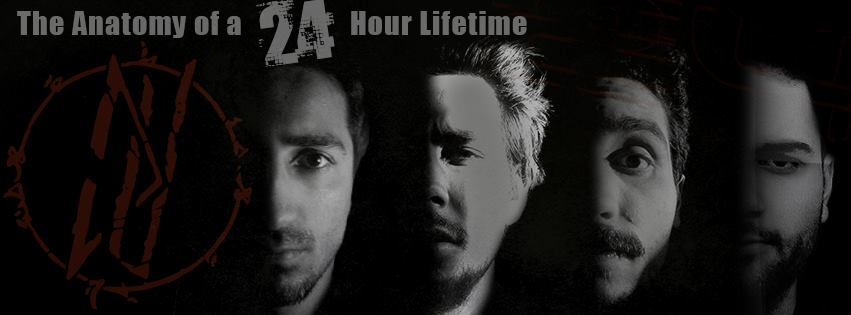
When Afghanistan’s first heavy metal band District Unknown [FOLLOW HERE] first performed in Kabul despite threats, they had their eyes on this moment. Today they release “The Anatomy of a 24-Hour Lifetime,” their first album, Afghanistan’s first ever heavy metal album. “Portraits,” their new music video produced by Jake Simkin, premieres in a few weeks. District Unknown’s full story will be told by filmmaker and Sound Central Festival founder Travis Beard in a new feature documentary premiering this fall called, RocKabul, aka Martyrs of Metal.
The album’s title track, “2 Seconds After the Blast” takes us beyond the psychadelic metal they were known for in Kabul into a doom dreamscape aimed more for a global audience. The song is a reflection on co-founder Qasem Foushanji’s close call on the streets of Kabul, a dirge, or dark poem about overcoming trauma. The album ranges from dreamscape metal meditations to growlcorefunk to psychedelic thunder.
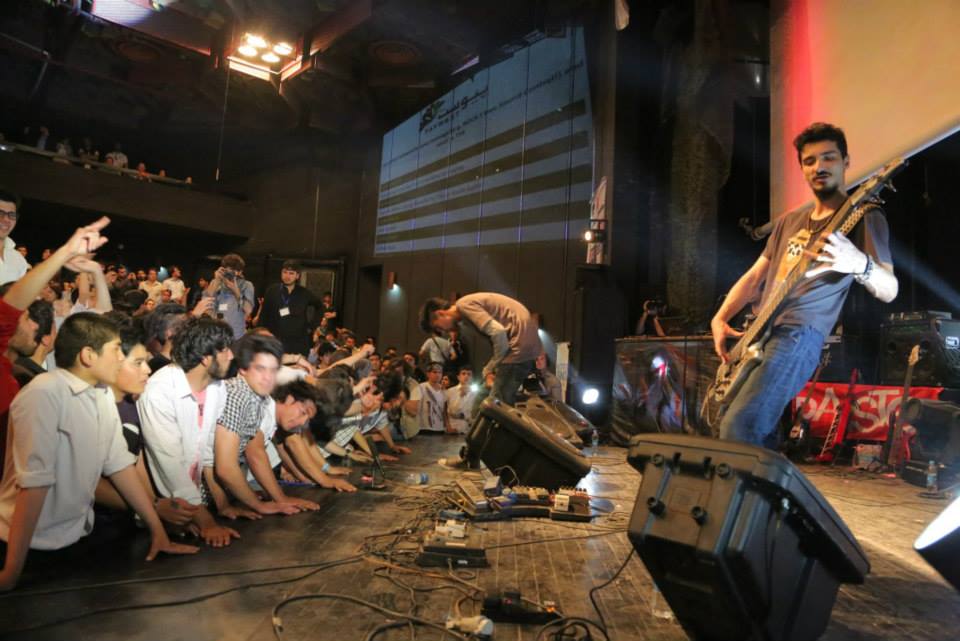
DANIEL J GERSTLE | HUMANITARIAN BAZAAR: Ever since Humanitarian Bazaar (then known as HELO Magazine) saw you at your first psychadelic metal show live at Sound Central Festival 2011 in Kabul, we have been looking forward to this first Afghan heavy metal album! Finally! I remember moshing with Qasem and Pedram and announcing you on the stage for that first show in the underground club Hoodies. Now, here we are and the fire has grown from the first songs into the full album. First, tell us what is the most surprising, innovative thing we can expect from this new music? What’s the them of this new album?
We really wanted to blow people’s minds before we melted their faces off! As far as the theme I’d say it’s a journey into the raw depths of life as young men in Afghanistan.
SULLY OMAR | GUITARIST & PRODUCER: People have got used to hearing a heavy, thundering wall of sound from DU due to circumstance and due to the emotion our music has always been charged with. The new album will catch many people off guard but will still retain the menacing sound that has always been DU. People aren’t accustomed to hearing a great amount of depth from DU but we’ve explored that in great detail with this album.
We really wanted to blow people’s minds before we melted their faces off! As far as the theme I’d say it’s a journey into the raw depths of life as young men in Afghanistan. There are parts that are disgusting, parts that are calm, parts that are inspirational and parts that are droning and dark. We really tried to capture all that. But aside from the tangible parts, this album has a foundation in surreal and abstract expression, so it would be quite contradictory of us to nail it down with a theme. So take that with a grain of salt. Also, headbanging.
DANIEL: Can you tell our audience, how did Afghanistan’s first heavy metal band rise in such a tough situation in Kabul these past years? And how are you now growing internationally?[columns][two-columns]
PEDRAM FOUSHANJI | CO-FOUNDER & DRUMMER: It was definitely with the help of expats. More specifically, fellows from White City, mainly Travis Beard. It was in late 2008 when I approached Travis through a friend and asked to practice drums in his practice room/home studio. We never let go throughout it all. We just badly wanted to continue; we loved our band. Qasem and I, both all-time members of the band, have held DU so dear and I think we always will.
We also got good feedback from the Afghan crowd, friends and family. It did give us more energy and the will to go forward. We always got asked about when we would have the album out and after the shows, we were asked about the next time we would perform; Questions that we never had the answer for.
We never worried about how big we were/are becoming. Although we become happy when more people understand our message, style and the perspective that comes with our music, we have been trying hard to keep it as genuine as possible. Of course with the release of Trav’s doco that followed the band for a good 5 years, we will attract a considerable amount of attention. But that will not make us “rock stars”. In other words, we write the music that makes us happy, if others like it too, cool, if not, too bad.
DANIEL: Tell us about each of your members and co-founders? You guys seem to range from heavy metal in the band to abstract art to jazz to construction to everything else outside the band, so what are your projects which cross-cut with District Unknown that people may also want to learn about? We especially want some detail about Qasem’s artwork.
PEDRAM: From the start to now, we have become less and less classically metal. We still love the genre, we play a kind of it, but we are trying to explore more than just that. Qasem, our bassist who created the theme for the album “Anatomy of a 24h lifetime”, and who is originally a visual artist, is actually starting an art project with the same theme as the album. It’s very interesting stuff, and for us it’s nice to have more iterations of our album’s theme being seen in visual art. On the other hand, when the singles get released, there’s going to be artwork for each song. These artworks have been chosen from a whole gallery of photographs and paintings by Qasem, Yo Khalifa and another visual artist and good friend of ours, Ramin Naqshbandi. After the album is out, their set will be exhibited with the same name as the album.
SULLY: In addition to District Unknown, I’m working with a group named Hybrid Pharaohs which includes Yo Khalifa (the lead singer of DU) and Shekeb Yaaghi. It’s an Afghan hip-hop trio in which I write the beats and our guys all get together, write, and jam out. It’s been a lot of fun and we’re working to get that off the ground. As is the case with DU, geography is a bitch and we’re scattered around the world at the moment. I’ve also worked extensively with an acoustic set with Pedram for our acoustic duo Dirty Jeans. It’s a chance for us to unplug and play a simple, fun instrumental set with sparse vocals. It’s got a lot of parallels with District Unknown, and the other guys in the band really dig it too.
One the great things about this band is that our members are involved in all facets of art. So we’ve all got these badass side projects that share much in common with DU, but with a different kind of synergy, a different kind of flair, a different edge. It’s cool shit, and we had a platform to share our other sides with people during Sound Central Festival 2013. A standoffish Afghan guy approached me after DU’s performance and told me he really liked what Pedram and I did as Dirty Jeans the day before, but was repulsed, even offended by the District Unknown performance.
I kept my cool and told him that different people have different tastes, and that nobody forced him to listen to anything. I told him that there’s a number of people like him that like our acoustic set, and that there’s an army of people that rock out with us as DU. I gave him choice, and that’s what Trav’s alternative music festival was all about from my understanding. Needless to say, he accepted my answer. We won.
DANIEL: Has heavy music been more of an art form, a social platform, or maybe a way to cope with hard times for you guys? Can you share some highlights of the new music, specific songs, or lyrics that helps us see your vision for this new album?
SULLY: Qasem had a vision of a concept album where songs would progress to one another much like a story with a beginning, middle, and end. We put the songs together in a way that would make sense for such a journey, but we didn’t want to have a predictable progression because our music is not written predictably.
We start the album by socking the listener in the mouth with Modern Nature, a short and sweet new composition with authentic DU flavor. Immediately we sink the audience into serious soundscapes and move into our next classic District Unknown track. Then we move into “2 Seconds After The Blast” written by Qasem to describe the immediate moments following his experience at the bombing of the Indian Embassy in Kabul.
To further flesh out his concept, we wrote a 10 minute intro section with experimental, droning pieces that reflect the mood of the moments leading up to the explosion (“Nothing seems right/ wherever we go/ Let me hold this/ no matter how far/ this district is unknown/ give me strength to go….”). The tracklist continues with some DU classics mixed with new compositions that people have yet to hear.
Martyrs of Metal-Trailer- June 2014 from Argus on Vimeo.
PEDRAM: We definitely have some complex feelings, emotions and thoughts that are being shared by releasing this album. The album is from deep inside of us for the outside.
SULLY: We are very happy with the final product and think it really comes together as a complete fucking thing.
DANIEL: Right, this classic concept of a story album, could apply so well to the theme of overcoming tough times. It’s bizarre more bands aren’t doing this to bring songs full circle into a whole. So, on that note, which other bands inspire you artistically and musically?
PEDRAM: Well, it IS a huge range. plus the fact that at different times, we listen to different stuff, we are maturing with our understanding of music every day. Qasem has playlists that range from God Speed you Black Emperor, and B’jork and suddenly old school SlipKnot. I love the drums, rhythms and complicating them. So I’d say I listen to more of prog rock and metal. I love Between the Buried and Me, Mastodon, Porcupine Tree and all the classic progs.
Yo explores everything, literally everything. He listens to hip hop one day and the next day he is listening to classical. The next day he’s listening to some 80s Anathema. He normally does not care about what’s new, but mostly about what’s new to him.
Part of the sound we have developed had much to do with Lemar who was very interested in dark music, which he explains as very different from heavy music. Qais, who played the guitars in more than half of the album, was into heavy metal.
SULLY: The band has a diverse range of inspirations and tastes. It’s part of what makes the band’s sound eclectic and unpredictable. Myself, I am heavily inspired by the sound of Nu Metal bands of the late 90s (bands I grew up on) such as Linkin Park, Korn, Rage Against The Machine, Limp Bizkit, and System of a Down.
I’m from a production background, so by default I see every genre of music as a challenge to be conquered. I am a huge fan of late 90s American hip-hop and modern electronic music. I also am greatly inspired and influenced by video game soundtrack producers, whose catchy tunes and themed compositions always painted a picture in my head.
DANIEL: Can you tell us about your spots on MTV, Creative Despite War, and the new documentary by Travis Beard?
PEDRAM: Well, with regards to the MTV show, I got a call from a friend and told me that I was on Netflix. It did sound very cool to them. With both MTV and the Creative Despite war, we did not promote them as the band. Because again, after the 2013 sound central festival we got misrepresented as fuckin’ Satanists, a story that is not even new about the band. I am not going to go through the details but those set of problems unfortunately ended up with Yo and Sully leaving Afghanistan. My leaving for my education was a coincidence though. That was not a good era…
Almost a year later now, we have reopened our facebook page, we are working on our website (that was firstly opened and supported with help from you guys at Humanitarian Bazar) and we are going as public as possible. We think, people will look back and laugh at those who were and are labeling us or threatening us. Although we do care about our security and life, withholding our album would not make things any more safe.
As far as Travis’ docu goes, we have a deal with Travis since day one, he gave us his gear, his practice room, and sometimes even mentored us, and in return all he wanted was the right to film us. It got to a point that it became a brotherhood and friendship. This film is going to expose a lot of DU. We are positive about the release of the docu and consider it as a promotion to the band’s existence.
One more thing that I’d like to add is that DU is not a finished project. Even now when album is out, we are constantly working on our next one or 2 singles with a much more matured approach.
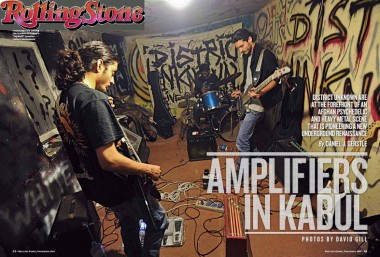
Featured in Rolling Stone. Photo: David Gill.
We are all around the world. This geography is the nature of DU, and it makes DU more than just a rock band. It’s an idea, an expression of the alternative culture that connects deeply with Afghanistan and us as Afghans.
DANIEL: Right, these days, bands like yours have to be global not out of a sense of market, but out of a sense of the true diaspora of your family and friends. So, when or how will fans be able to see you live?
PEDRAM: As right now, we won’t be able to play live, since the band members are all around the world. We are thinking of touring sometime next year. Things are constantly changing about us as the members. All we know that is vital for now for each of us, is growing as musicians and maturing our sound even more. We prefer organic growth. And that cannot be forced.
DANIEL: Just let us know when you do prepare to go live, or at least are ready for super fans who want to book you. We have already discussed with Iraqi metal band Acrassicauda, Syrian prog rock band Rasas, and others about pulling together a frontline rock festival, if not a tour of bands overcoming the toughest barriers. Looking at the difficulties for heavy music groups in places like Syria or Iraq, or even deep end Detroit, what kind of advice do you have for getting over these huge barriers?
PEDRAM: Be yourself. Don’t do things cause they’re the “right thing” by someone else’s standards. Believe in yourself and what makes you happy.
We have been made fun of, harassed, threatened where we’ve been doing it. And it was not just the conservative groups, even most famous pop artists accused us for the type of music we play. But every time we were asked “why do you do this?” we answered “because we love it, because it’s our nature.”
DANIEL: Back sharper to the main point: What are you trying to achieve with this album?
SULLY: First and foremost, it is important for us as a band to lay down our music on a concrete, high quality format because we firmly believe that we are making history with heavy music in Afghanistan. If not for our fans, at least for our friends and family; they need to know that we had the balls to create and play this type of music in what was really a counter-culture movement. Secondly, there are a lot of people who insisted that a professionally recorded album could not be executed in Afghanistan.
With the help of Travis Beard, who assembled “Labra-Tora-Bora” in his backyard in Kabul, we proved that this is not the case. To my knowledge, we are the only Kabul-based band who recorded our own music in Afghanistan and mixed our own tracks without the need of foreign studios, sound engineers, and instrumentalists. I’m not taking a cheap-shot at our brothers and sisters who are playing in Kabul and abroad, but facing these circumstances with reasonable success took me years of unguided dedication and it took our band an undeniable amount of conviction to stay engaged and unified while we were spilt across the world like the seven seas.
It takes a lot of courage and confidence to trust your own hands and ears to do this and I’m proud of our guys for plunging themselves in head-first with me. To answer your question in shorter terms: We hope to show people one of the most unique faces of alternative music coming out of Afghanistan. We have allies around the world who are playing heavy music in similar situations with similar stories, and this album is a stamp of solidarity from District Unknown.
The album is last but not least the culmination of several tough years of finding a sound and expressing the depth within ourselves and the art within our souls. Artists create, and even though it took us forever, we created.
PEDRAM: Sure it took us a while to get it together and release it. But the fact is, that we did it regardless of all the troubles. We are celebrating the release of this album. This is a win for each of us as members. Also, this might be the right time to thank the people supporting us from the beginning till now. Families, friends, Afghan and international supporters. We are blessed to have them all in our lives.
DANIEL: Many outside West Asia may not fully understand how much harder it must be to produce music and concerts in a place like Kabul, where music used to be illegal, much less to do it with a heavy, confrontational genre, during an ongoing war. Kids in California are complaining their rehearsal space is too far from the beach. You guys have to cross through armed checkpoints to get to yours. So, now that you’re launching the album virtually, how do people buy or download music and art?
SULLY: We have a music video for the song “Portraits” that Jake Simkin directed and produced for us. So with the release of the album, people have something to look at as well. The album is free to listen to, on Soundcloud and youtube. And if someone wants to download it, it is available on iTunes.
TASHAKOR! THANKS GUYS!